













European windows have set the global standard for tilt and turn window engineering for decades -- and Minnkota builds them here in the USA.
As we continue to explore Europe’s window industry, Day Two took us beyond the trade show floor and into a real-world manufacturing environment.
While Fenstebau Frontale offers a broad look at innovation across the industry, visits like this provide something just as valuable—a chance to see how other fabricators operate day-to-day. From automation to materials to workflow, these experiences allow us to compare, learn, and evaluate how different approaches could influence the future of Minnkota Windows.
Here’s a closer look at Pat’s visit to a German fabricator and what stood out most:
____
We planned to take a short break from Fensterbau Frontale 2026 today with a trek to visit a window fabricator in Schnelldorf, Germany. This was just over an hour, by bus on the Autobahn, to Kneer-Sud Fenster in Schnelldorf. I was excited to visit and compare their way of fabricating to that of Minnkota Windows.
There were several differences, but also many similarities. Unlike Minnkota Windows, where we only fabricate PVC windows, Kneer-Sud fabricates several different types of windows: all-PVC, PVC/aluminum clad, and wood windows. The wood windows are produced in a separate building from the PVC and PVC/Aluminum units. Additionally, where we only fabricate REHAU PVC profiles, Kneer-Sud has a few different profile suppliers.

Like us, they're still a family business. Them: eight decades! Us: a little more than half of that. They also, like us, are a B2B fabricator and don't sell direct to the end-user.
PVC Fabrication: How European Windows Are Made
For the purposes of this entry, I'm going to focus on the PVC fabrication since it's so closely related to what Minnkota Windows specializes in.
Automation vs Craftsmanship in Window Manufacturing
The biggest fabrication difference is their automation. Nearly every fabrication process Kneer-Sud employs has some type of automated machine to do the heavy lifting. They have machines that cut, rout, and clean profiles from beginning to end. Several steps are completed from the time the profile is fed into a machine until another human puts their hands on it. By comparison, we have manually operated saws, punches that rout for hardware and water drainage that need to be administered by one of our Production Associates.
We are similar at this point of the process, where someone has to feed the four-point welder to have the four pieces welded into the rectangle that will ultimately end up as a finished frame or sash.
In our plant, welded frames and sash get hardware, balances, and accessories fastened manually. Since Kneer-Sud primarily fabricates Tilt/Turn windows, much of this is performed by automated machines and robots. The screws are even inserted by machine, not a hand-held drill!

Glazing: How Europe and the US Approach Glass
Their glazing line is remarkably different than ours also. A sash is put on a conveyor in a vertical position. It slides down the line where a lift-assist device fitted with suction cups positions the glass into the sash. The next stop on the line receives the shims and the final stop is the glazing bead that holds the glass into place in the sash. All of these processes are completed by multiple individuals.
They get our insulated glass units from a supplier much like we do from Cardinal IG. Many U.S. window manufacturer's produce their own IG units. We're more similar to Europe in that we get complete IGs without having to deal with creating our own glass packs. Like Europe, we like to leave the glass element to the professionals!
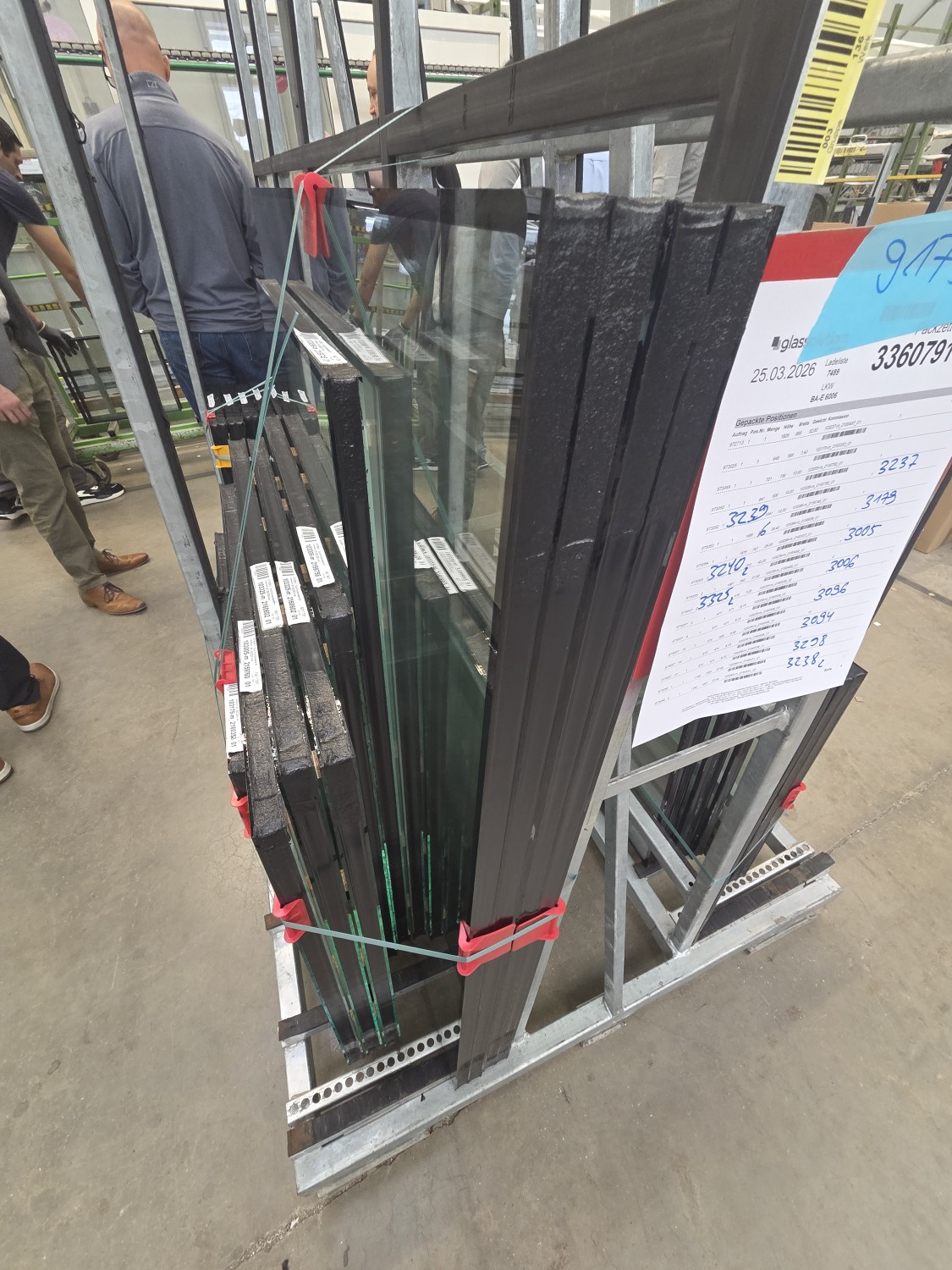
Our process for glazing those IGs is much different currently. Sash are placed on a table horizontally, an Associate finds the glass from the rack and lays the glass into place. Then the shims and glazing beads are added to complete the process. This is mostly done by a single Associate.
From this point forward, there are many similarities. Windows are completed by job, or sales order. They're staged for shipping and loaded on racks or skids to enter the shipping container or trailer.
Similar to Minnkota Windows, they have specialty areas on the floor for special shapes, doors and the oddball units they produce for their customer base. However, they don't shrink wrap anything for delivery. Everything that goes on a rack gets a piece of what looks like carpet pad to separate the windows and keep them from rubbing upon one another.
The absolute biggest difference between Kneer-Sud and Minnkota is what is done with the scrap profile material. In Europe, all the unused profile material is sent back to the supplier to be reused in future fabrication of windows and doors. We're not quite that advanced in recycling in the U.S. as what's demanded in Europe.
In all, Kneer-Sud and Minnkota Windows aren't all that different; the goal is a high-quality product shipped to customers on a timely basis. We both get from A to Z a little differently, but we're very similar in what we do.
It was very interesting to see their operation, and I thank Stefan and Gustav for their time and hospitality during our visit.
We're now on the back half of the trip, but still have lots to experience and learn. More to come from the show before we're done.
Wir sind noch nicht fertig!
What We Brought Back to Minnkota
Experiences like this reinforce an important takeaway: while methods and technology may vary, the goal remains the same: delivering a high-quality product efficiently and consistently.
As we continue through the back half of the trip, we’re excited to keep learning, asking questions, and identifying opportunities that could help shape what’s next for Minnkota Windows.
To learn more about tilt and turn windows, see our guide on what a tilt and turn window is, or explore the full Euro Series on our tilt and turn windows and doors page.